
"STRIDE wasn't written for agents that call tools and read untrusted documents — but the categories still map, once you know where to look."
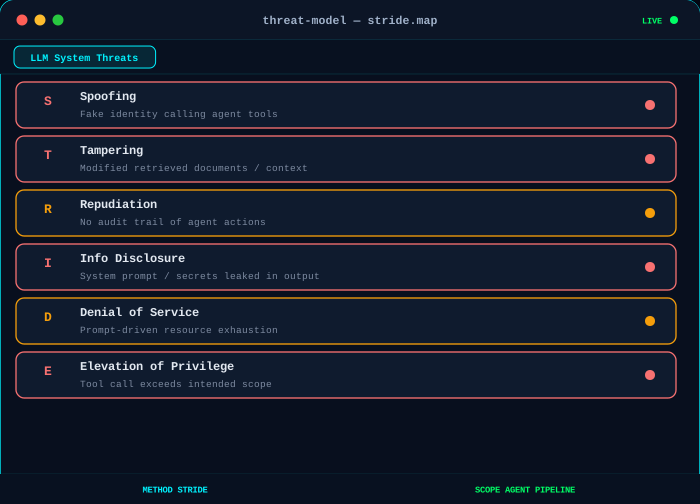
Microsoft's STRIDE framework (Spoofing, Tampering, Repudiation, Information Disclosure, Denial of Service, Elevation of Privilege) predates LLM agents by two decades. It still applies — this piece maps each category onto an agent/RAG pipeline's actual components.
1. The Six Categories, Mapped to an Agent Pipeline
Each STRIDE category has a concrete, non-hypothetical analog in a typical agent/RAG system. Treating these as abstract categories rather than specific failure modes is how threat models end up too generic to act on.
Modeling Principle
Map each category to a specific component — not a generic "AI risk" bucket.
2. The Highest-Priority Categories for Agent Systems
- Tampering: retrieved documents and tool outputs are attacker-influenceable input, not trusted context — treat them accordingly.
- Information Disclosure: system prompts, credentials, and other-tenant data can leak through model output if boundaries aren't enforced server-side.
- Elevation of Privilege: a tool call that can be steered beyond its intended scope is a privilege escalation path, not a UX bug.
3. Applying This to a Real Pipeline
| Component | Primary STRIDE exposure |
|---|---|
| User input / prompt | Spoofing (identity), Tampering (injected instructions) |
| Retrieval / RAG documents | Tampering (indirect prompt injection via retrieved content) |
| Tool-call execution | Elevation of Privilege, Denial of Service |
| Model output | Information Disclosure (leaked secrets/context) |
| Audit / logging layer | Repudiation (no record of what the agent actually did) |
4. What This Is Not
This is not a replacement for a full security review — it's the structuring step that makes a review comprehensive instead of ad hoc. A threat model without a follow-up mitigation owner per finding is a document, not a control.
Skills Demonstrated: Threat Modeling · AI Agent Security · RAG Security · STRIDE Methodology
Related service: AI Agent Security · Related: RAG Security