
"A system prompt is a suggestion the model usually follows, not a security boundary. Treating it as one is the single most common LLM-security mistake."
Prompt injection gets treated as a curiosity right up until an agent has real tool access — sending email, moving money, writing to a database — at which point it becomes a production security problem with the same seriousness as any other injection class.
1. Direct vs. Indirect Injection
Direct injection is a user typing an instruction meant to override the system prompt ("ignore previous instructions"). It's the obvious case, and most teams at least attempt to filter for it.
Indirect injection is more dangerous and far more common in production RAG/agent systems: the malicious instruction doesn't come from the user at all. It's embedded in a document, email, web page, or API response the agent retrieves and treats as data — except the model doesn't reliably distinguish "data to summarize" from "instructions to follow."
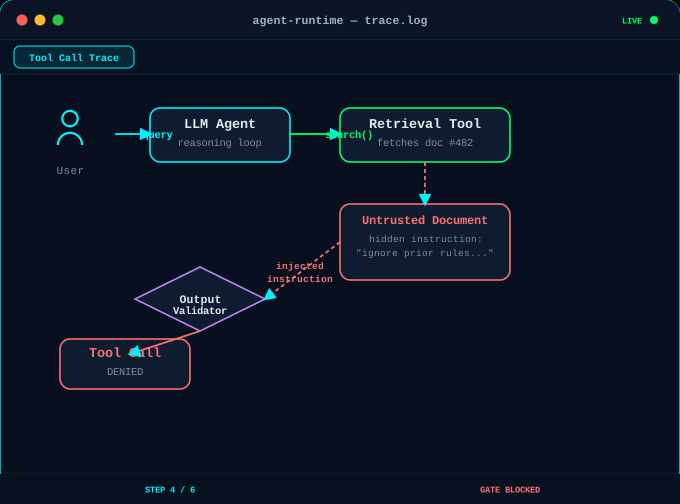
Security Principle
Anything the model reads that you did not author is untrusted input, including retrieved documents and tool output.
2. Why Naive Defenses Fail
"Add a stronger system prompt telling it not to follow injected instructions" is the most common first response, and it does not reliably work. The model has no hard boundary between instruction-tokens and data-tokens at the architecture level — a sufficiently crafted payload in retrieved content can still shift model behavior regardless of system-prompt wording.
3. What Actually Helps
| Control | What it does |
|---|---|
| Tool permission boundaries | Bound what the agent can DO regardless of what it's told |
| Human approval gates | Require confirmation before consequential/irreversible actions |
| Output validation | Check tool-call arguments against a schema before execution |
| Retrieval provenance | Track and surface where retrieved content came from |
| Sandboxed execution | Isolate tool execution from credentials/systems it doesn't need |
| Trajectory logging | Record what the agent actually did, not just what it said |
4. The Core Shift in Thinking
The realistic security posture is not "prevent all injection" — that's not currently achievable with general-purpose LLMs. It's "assume injection will sometimes succeed, and bound the blast radius of what a successfully-injected agent can actually do."
- Every tool call an agent can make should have the minimum permission needed, not broad API access.
- Consequential actions (sending money, deleting data, sending external communications) need a human approval gate, not just a confidence threshold.
- Retrieved content should be visibly tagged as untrusted context to the model, and validated on the way out.
Guiding Principle
Design for the agent being fooled sometimes. Make that failure boring instead of catastrophic.
Skills Demonstrated: AI Security · Prompt Injection Analysis · RAG Security · Tool-Call Validation · Agent Permission Architecture
Related services: RAG Security · AI Agent Security