
"Web applications are accessible 24/7 to the entire world by design. That accessibility makes the web our greatest operational capability—and our most exposed security boundary."
As part of my ongoing cybersecurity learning journey and technical assurance research, I completed the Web Security Essentials room on TryHackMe. The web has fundamentally changed how software is delivered: from e-commerce and banking to enterprise collaboration, media editing, and cloud administration, virtually every critical digital system now operates through a browser interface.
However, the advantages of web applications—continuous availability, global reach, and instant deployment—introduce severe security challenges. Because web applications are permanently exposed to the public Internet and directly connected to backend databases and cloud environments, they represent the primary initial foothold for attackers.
Rather than treating web servers, WAFs, and code in isolation, this walkthrough establishes a unified defense-in-depth architecture centered around one core question: how does HTTP traffic move through each layer of the web stack, and where can we inspect, filter, and contain it?
1. From a Security Perspective: The Dual-Sided Risk Model
Evaluating web risk requires understanding both perspectives: the organization operating the web service and the individual user interacting with it.
| As a Web App Owner / Defender | As an End User / Consumer |
|---|---|
| Your application is exposed to the public Internet 24/7/365. | Your sensitive data is stored on third-party backend servers. |
| Anyone worldwide can probe endpoints and hunt for zero-days. | A browser compromise or session hijacking exposes multiple accounts. |
| Defenders must continuously patch emerging CVEs and dependencies. | A backend data breach results in identity theft or financial loss. |
| You bear legal and regulatory liability under KDPA, GDPR, and PCI-DSS. | Your personal privacy can be permanently compromised. |
Core Security Principle
A vulnerable web application is rarely the attacker's final objective; it is almost always the initial bridge into an organization's internal cloud and database infrastructure.
2. Real-World Case Study: Capital One SSRF & WAF Misconfiguration
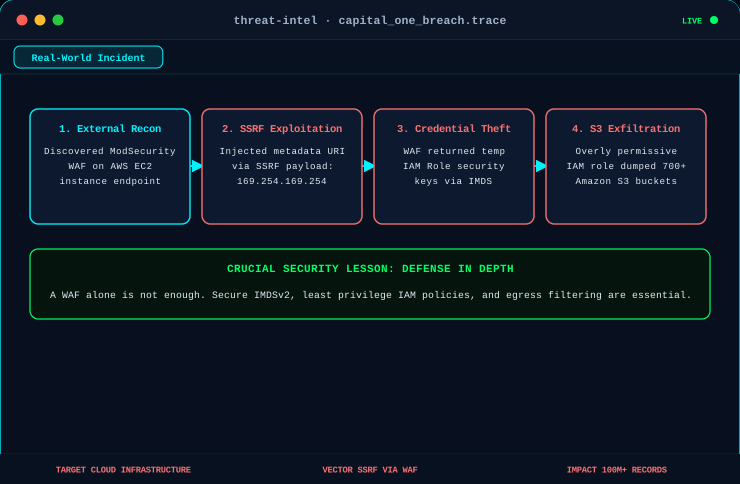
In 2019, Capital One experienced one of the most widely publicized cloud breaches in history, resulting in the exposure of over 100 million customer credit applications and financial records. The incident illustrates why relying solely on perimeter defenses is catastrophic.
The breach occurred through an open-source ModSecurity Web Application Firewall (WAF) running on an Amazon EC2 instance. The attacker exploited a Server-Side Request Forgery (SSRF) vulnerability within the WAF itself to query the internal AWS Instance Metadata Service (http://169.254.169.254). The metadata response leaked temporary IAM credentials associated with the WAF instance's IAM role. Because that IAM role was granted excessive permissions, the attacker was able to run automated sync commands against more than 700 Amazon S3 storage buckets.
Assurance Takeaway
A WAF alone is not enough. Defense-in-depth requires least-privilege IAM roles, IMDSv2 session-token enforcement, and strict egress filtering.
3. Web Infrastructure & The HTTP Request-Response Lifecycle
Every web interaction relies on the client-server request-response model. When a user requests a URL, the client browser constructs an HTTP/HTTPS request, resolves DNS, traverses network boundaries, and reaches the web server. The server processes headers, verifies authorization, executes backend logic, queries databases, and returns an HTTP response (HTML, JSON, or media assets).
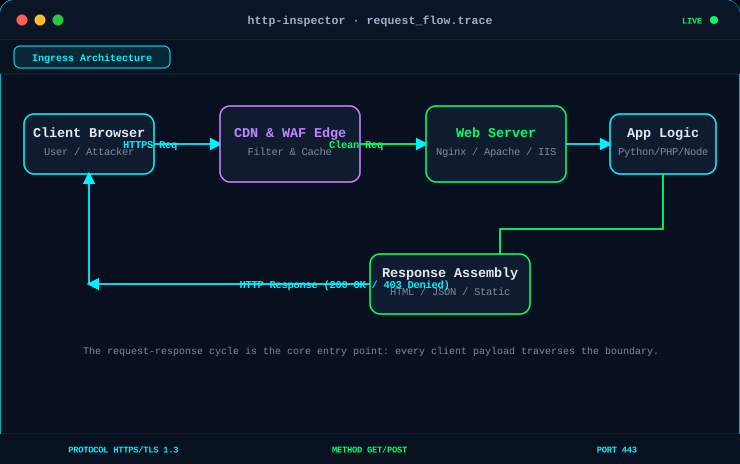
Attackers abuse this request-response cycle through several primary mechanisms:
- Request Flooding (DDoS): Overwhelming web servers with connection floods to exhaust CPU, memory, or bandwidth.
- Parameter Manipulation & Injection: Embedding malicious SQL, XSS payloads, or OS commands inside query parameters, headers, or POST bodies.
- Access Control Bypasses: Tampering with session cookies, JWT tokens, or object IDs (IDOR) to access unauthorized backend data.
4. The 3-Tier Web Service Architecture & Attack Surface
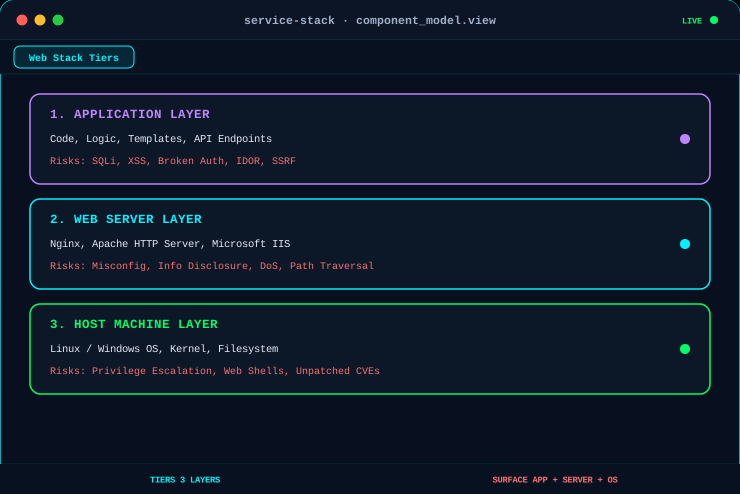
To defend web applications effectively, we must decompose the service into three distinct functional tiers. A vulnerability in any tier can compromise the integrity of the whole system.
| Component Tier | Core Role & Technologies | Primary Threat Vectors |
|---|---|---|
| 1. Application | Business logic, user authentication, templates, REST APIs (Python, PHP, Node.js, Go, Java). | SQL Injection, Cross-Site Scripting (XSS), IDOR, SSRF, Broken Authentication. |
| 2. Web Server | Listens for incoming HTTP requests, terminates TLS, routes traffic, serves static assets (Nginx, Apache, IIS). | Server misconfiguration, unpatched CVEs, directory traversal, info leakage, denial of service. |
| 3. Host Machine | Underlying OS (Linux/Windows), kernel, filesystem, system daemons, network interfaces. | Privilege escalation, web shell deployment, weak permissions, unpatched OS exploits. |
5. Protecting the Web Ecosystem: The Three-Tier Defense Triad
Defending web applications requires synchronized controls across all three tiers:
A. Protecting the Application Layer
- Secure Coding: Avoid dangerous execution functions (e.g.
eval(),system()), handle exceptions cleanly without leaking stack traces, and never hardcode API keys or credentials. - Input Validation & Sanitization: Implement strict server-side whitelisting and utilize parameterized SQL queries (prepared statements) to prevent injection attacks.
- Granular Role-Based Access Control (RBAC): Enforce authorization checks at every sensitive endpoint and object query.
B. Protecting the Web Server Layer
- Comprehensive Access Logging: Record detailed telemetry for all HTTP requests to feed real-time SIEM analytics.
- Web Application Firewalls (WAF): Inspect HTTP payloads and block malicious traffic based on security rules.
- Content Delivery Networks (CDN): Shield the origin IP address, enforce TLS encryption, and absorb high-volume DDoS floods.
C. Protecting the Host Machine Layer
- Principle of Least Privilege: Run web server daemons under non-privileged service accounts (e.g.,
www-data,nginx) with restricted shell access. - System Hardening: Close unused ports, disable unnecessary background services, enforce strict filesystem permissions (
chmod / chown), and disable directory listing. - Endpoint Antivirus & Integrity: Deploy endpoint protection agents to detect and neutralize web shells and malicious executables.
Universal Security Baseline
Enforce Multi-Factor Authentication (MFA) across all admin panels and maintain an Automated Patch Management Cadence for OS kernels, server binaries, and application packages.
6. SOC Access Log Analysis & Attack Forensics
Web server access logs are the primary source of forensic evidence during incident investigation and threat hunting. Each log entry records the client IP, timestamp, HTTP method, URI path, HTTP status code, response size, and User-Agent string.
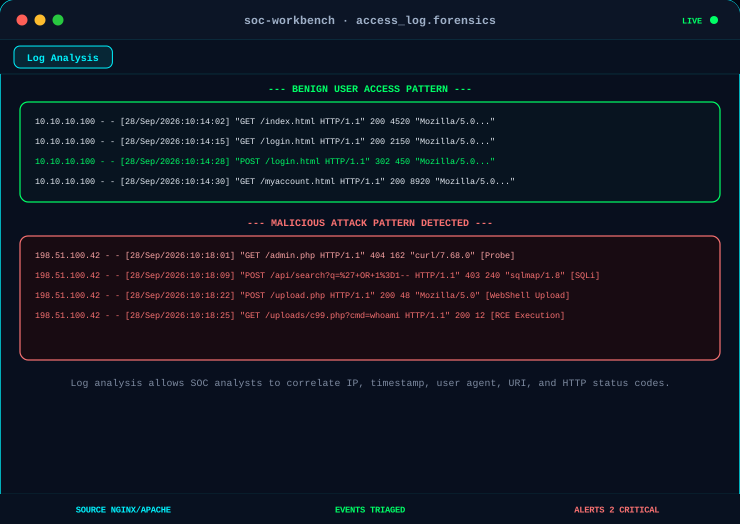
Comparing benign traffic with malicious patterns reveals clear indicators of compromise:
- Benign Flow: User at
10.10.10.100accesses/index.html(200), navigates to/login.html(200), submits credentials viaPOST(302 redirect), and views/myaccount.html(200). - Malicious Flow: Attacker at
198.51.100.42probes for hidden admin panels (/admin.php404), launches automated SQL injection withsqlmap(403 blocked by WAF), exploits an unsecured upload endpoint (POST /upload.php200), and executes arbitrary OS commands via a web shell (/uploads/c99.php?cmd=whoami200).
7. Defensive Architecture: Content Delivery Networks (CDNs)
A Content Delivery Network (CDN) caches and delivers content from distributed edge servers located close to users. While engineered for speed, CDNs serve as a critical perimeter defense:
- Origin IP Masking: Hides the backend server IP behind the CDN reverse proxy, preventing direct-to-origin attacks.
- DDoS Mitigation: Anycast edge routing absorbs massive volumetric DDoS floods before they reach infrastructure.
- Enforced HTTPS: Enforces modern TLS 1.3 encryption by default across all client communication.
- Integrated Cloud WAF: Inspects and filters malicious requests directly at edge locations worldwide (e.g. Cloudflare, AWS CloudFront, Azure Front Door).
8. Defensive Architecture: Web Application Firewalls (WAFs)
A Web Application Firewall acts as an intelligent digital bouncer for web traffic. Unlike network firewalls (Layers 3/4) that inspect IP addresses and ports, a WAF operates at Layer 7, deeply inspecting HTTP request bodies, headers, and query strings.
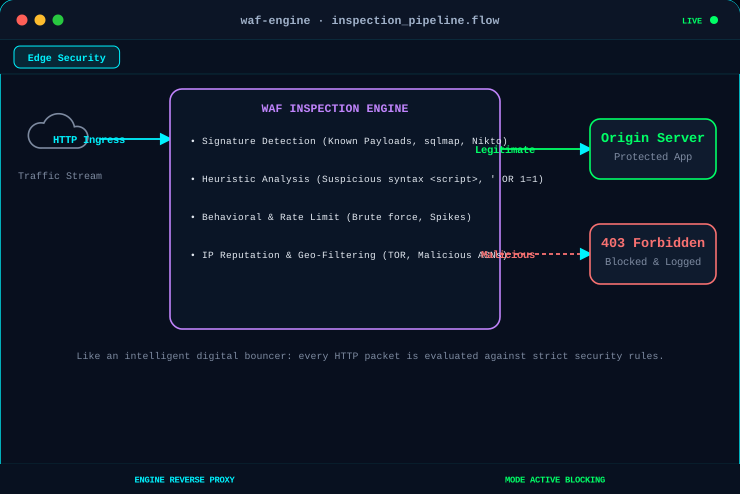
| WAF Detection Engine | Operational Mechanism | Practical Example |
|---|---|---|
| Signature-Based | Matches payloads against databases of known attack patterns, CVE strings, and tool signatures. | Blocking automated scanners with User-Agent header sqlmap/1.8.1 or Nikto. |
| Heuristic-Based | Analyzes syntax and context for suspicious code patterns and characters. | Detecting unescaped script tags <script> or boolean SQL injection ' OR 1=1--. |
| Anomaly & Behavioral | Flags deviations from established baseline traffic and request frequency. | Rate-limiting a single IP address generating 50 failed login attempts within 10 seconds. |
| Geo-IP & Reputation | Blocks or challenges requests from malicious ASNs, TOR exit nodes, or unauthorized geographies. | Restricting administrative backends strictly to domestic corporate IP ranges. |
9. Host-Level Antivirus & Web Shell Defense
A common misconception is that Antivirus (AV) is redundant in web security because attacks target application logic. However, AV and Endpoint Detection and Response (EDR) agents play a vital role in host-level containment.
When an attacker exploits a file upload or remote code execution flaw, their goal is typically to deploy a web shell (e.g. c99, r57, or custom obfuscated PHP backdoors). Host AV agents detect these malicious files via signature matching and behavioral heuristics (e.g. detecting the web server process www-data spawning an interactive shell /bin/bash), neutralizing the intrusion before privilege escalation.
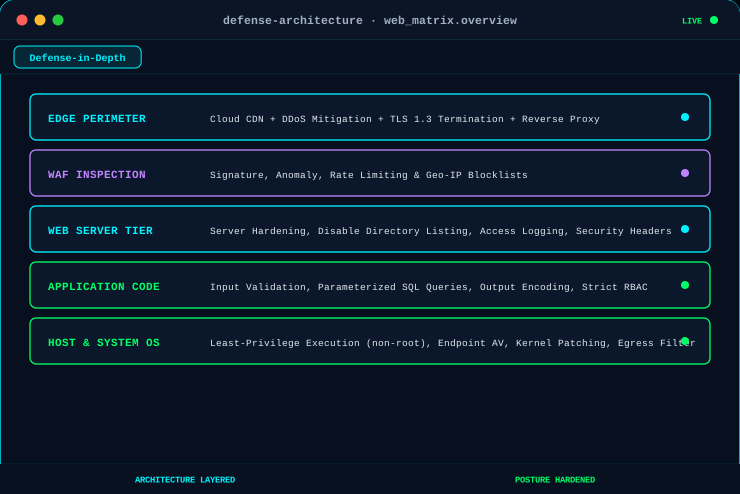
10. Multi-Layer Web Defense-in-Depth Architecture
Resilient web security requires every layer to reinforce the others. If a WAF fails, application validation must prevent execution; if code fails, host hardening and least privilege must contain the damage.
11. Practical Takeaways
Completing this walkthrough connects networking fundamentals with modern application security architecture:
| Web Security Concept | Defensive Function & Assurance Relevance |
|---|---|
| Request-Response Lifecycle | Core communication pathway; every parameter and header represents an ingress inspection checkpoint. |
| 3-Tier Architecture | Separates Application logic, Web Server routing, and Host OS into discrete security zones. |
| WAF Filtering | Enforces Layer 7 payload validation using signature, heuristic, behavioral, and reputation models. |
| CDN Edge Shielding | Cloaks origin server IP addresses, terminates TLS, and absorbs volumetric DDoS floods. |
| Access Logging | Provides structured forensic telemetry (IP, URI, status, user-agent) necessary for SOC triage. |
| Least Privilege & Hardening | Restricts web daemons to non-root accounts and isolates filesystem write permissions to stop web shells. |
| Defense-in-Depth | Ensures no single point of security failure exists across the entire technology stack. |
12. What This Means for My Cybersecurity Journey
This lab reinforces a central principle of cybersecurity assurance: vulnerability assessment is not about clicking automated buttons in a scanner; it requires a deep understanding of how the web stack functions from end to end.
Before evaluating any web application, an assurance analyst must answer critical architectural questions:
- What web server and runtime frameworks power the application?
- Is the origin IP masked behind a CDN reverse proxy or directly exposed to the public Internet?
- How are incoming parameters validated and sanitized before database execution?
- What Layer 7 WAF rules are actively inspecting payloads?
- Are web daemons executing under strictly isolated, unprivileged service accounts?
- Are web access logs centralized, tamper-proof, and continuously monitored by a SOC?
Mastering these fundamentals strengthens every area I practice as an assurance lead—including web application penetration testing, vulnerability assessments, defensive cloud architecture, SOC operations, and KDPA compliance assurance.
Final Reflection
The core lesson from Web Security Essentials is that security cannot be bolted onto a single tier. An impenetrable application can still fall to an unpatched web server CVE; a fortified WAF can be bypassed if backend cloud IAM roles are overly permissive.
Defensive Guiding Principle
Understand the request. Inspect the boundary. Harden the host. Defend in depth.
Skills Demonstrated: Web Application Security · HTTP/HTTPS · WAF Configuration · CDN Edge Protection · Access Log Analysis · Incident Forensics · Host Hardening · Least Privilege · Defense-in-Depth · Threat Modeling · Cybersecurity Assurance